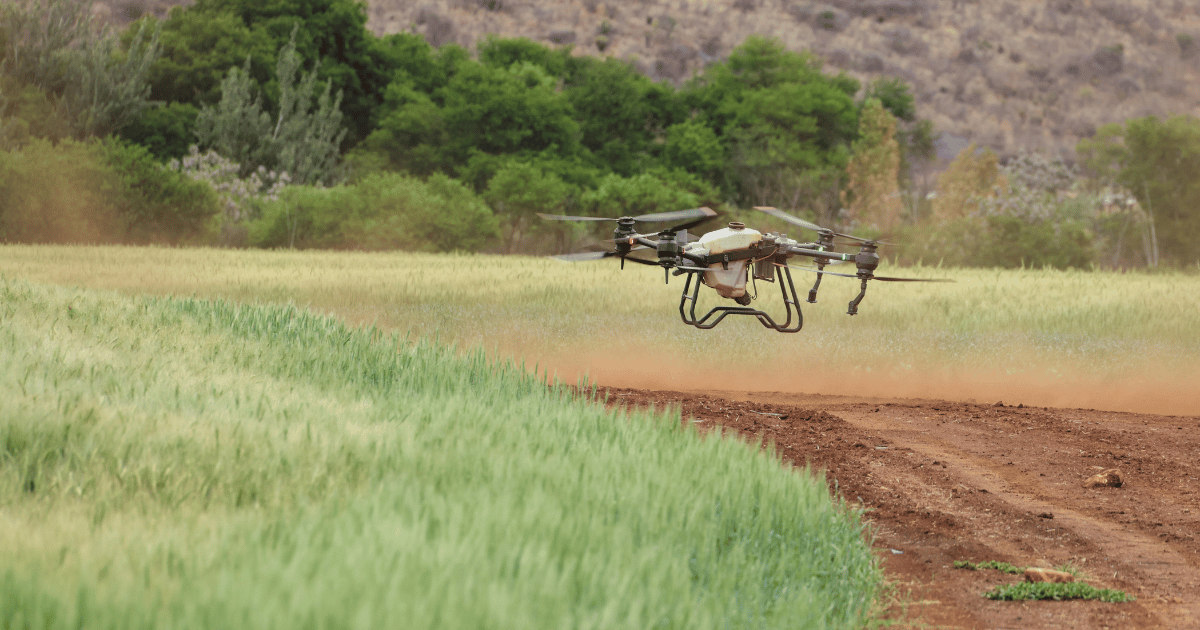
There’s no single correct number here. Anyone who hands you one flat figure without first asking what you’re spraying, what it’s for, and which drone you’re flying is oversimplifying the question. That said, there is a real, well-documented range worth knowing before you calibrate a program or size up a provider’s quote.
The short version: most agricultural spray drones work somewhere between 10 and 60 liters per hectare, roughly 1 to 6.4 gallons an acre, which is well below the 500 to 2,000-plus liters per hectare that knapsack or mist-blower equipment typically needs on tree crops. Where you actually land inside that range comes down to a handful of things, plus which drone and which spraying method is doing the work, which we’ll get into further down.
What Actually Determines the Rate
Canopy is usually the first factor. Field crops like rice, maize, or vegetables sit low and relatively flat, so they don’t need much volume to get full coverage, often landing in the 15 to 25 liter per hectare range. Tree and orchard crops are a different story. Oil palm in particular has a tall, dense, multi-layered canopy, so the spray usually needs more volume just to punch through from the top fronds down to where pests like bagworm are actually feeding.
What you’re targeting matters just as much. A contact insecticide has to physically land on the pest and the surrounding foliage, so it needs thorough coverage. A systemic product, by contrast, gets absorbed and moves through the plant on its own, so it doesn’t need the same density of droplets. Fungicide programs for something like anthracnose tend to sit closer to the insecticide end, since uniform coverage really is the whole point.
Droplet size and nozzle setup add another layer. Finer droplets spread across more surface area per liter, which sounds efficient, but they also drift more easily in wind. Coarser droplets hold their line better but need a higher volume to achieve the same coverage. None of this is fixed in advance; it’s a calibration call the operator makes on the day, depending on conditions.
And then there’s the one factor that overrides everything else: the chemical label. Every agrochemical product specifies a minimum water volume for its active ingredient to actually work as tested, and no drone spray rate should ever be set below what that label calls for, no matter what the drone is technically capable of. This isn’t really a drone question at all. It’s a regulatory and efficacy question first, and the drone’s droplet and drift behavior only get adjusted within that floor, never below it.
Pro-tip for operators
Don’t calibrate on faith. Verify it on paper, literally. When you’re setting up a spray mission, lay out water-sensitive cards across a test row and run a pass at your target volume, say 30 liters per hectare. The cards change color wherever a droplet lands, so you can count droplets per square centimeter afterward and confirm the coverage is dense enough to be effective, without leaving gaps between passes or pooling that wastes chemical and adds runoff risk. This isn’t an extra step tacked on for thoroughness. It’s the same calibration method used in published oil palm bagworm-control trials in Malaysia and in commercial drone-spraying efficacy studies more broadly, so it’s standard field practice at this point.
Worth repeating this check any time the chemical, canopy stage, or drone model changes. A coverage pattern that’s validated on one setup doesn’t automatically carry over to another.
Why Drone Rates Are So Much Lower Than Conventional Spraying
Here’s the part worth pointing out to a plantation manager or a procurement lead comparing costs. A field trial on oil palm replanting land in Jerantut, Pahang put drone application head to head against a mist blower and a conventional knapsack sprayer. Drone spraying cut water consumption by 91 percent, working hours by 37 percent, and labor expenses by 81 percent against the conventional methods. The same study also found drone spraying became the more cost-effective option once estates crossed roughly 3,000 hectares, with savings ranging from 4 to 28 percent.
That 91 percent water reduction is really a spray-volume story underneath the headline number. The drone gets acceptable coverage and efficacy at a fraction of the liters per hectare that ground equipment requires, simply because it’s applying a finer, more targeted droplet exactly where it’s needed instead of drenching the whole canopy and understory along the way.
Why “L/ha” Means Something Different in Blanket vs. Spot Spraying
This is where most L/ha figures floating around online start to get misleading, because they rarely specify which of two very different numbers they’re actually describing.
Blanket spraying treats the entire block as the target area. The drone flies the whole canopy at a uniform rate, so the volume applied and the volume calculated over total block area end up being the same figure. If the label calls for 30 liters per hectare, that’s what gets applied across every hectare the drone flies.
Spot spraying works differently. It only treats specific points, whether that’s a palm’s crown where a pest colony has concentrated or the individual zones a mapping flight has flagged as affected. Within that treated spot, the chemical is still applied at the label’s required rate and concentration. But since the drone skips everything outside those spots, the volume worked out over the total block area drops sharply, often to a fraction of the blanket figure, simply because most of the block was never sprayed at all.
That’s why a vendor claiming eight liters per hectare and another claiming forty liters per hectare aren’t necessarily contradicting each other, and might not even be describing different chemicals. One could be reporting a spot-spraying average diluted across the whole block, while the other reports a blanket rate applied everywhere it flies. Neither number tells you much about efficacy on its own until you know which one you’re looking at, and how much of the block was actually treated.
In practice, this means asking a provider whether their quoted figure is a block average or a treated-area rate, since the two aren’t interchangeable and comparing them side by side is really comparing two different things. Blanket spraying still makes the most sense for uniform threats such as young replants, full-canopy fungicide programs, or outbreaks that have already spread across a block. Spot spraying earns its place when the problem is localized, like early-stage pest colonies or isolated stress zones a mapping flight has picked up, where treating the whole block would just waste input on healthy palms. Neither method replaces the other. Which one applies is a decision made per block, sometimes even per flight, based on how the threat is actually distributed on the ground.
The Practical Takeaway for an Estate
If a provider quotes a single flat L/ha number before even asking what you’re spraying and why, that’s usually a sign they’re reusing one setting rather than calibrating per job. Worth asking what the target actually is, whether that’s a pest, a disease, or a fertilizer pass, and what the product’s label specifies as its minimum water volume. Worth asking about canopy density and height too, and whether flight height and speed have actually been adjusted for it. And it’s fair to ask whether the rate gets calibrated block by block, or just applied uniformly across the whole estate regardless of how much the canopy varies.
A provider who can walk you through all three, and show the calibration behind the number rather than just quoting one, is the one actually running a precision program. Anyone who can’t is probably just flying a drone with a fixed nozzle setting and calling it precision spraying.
Three Drones, Three Volume Profiles
Tank size alone doesn’t set the L/ha rate. Still, these three drones represent genuinely different volume profiles in practice, simply because of what each one is actually built to do.
Start with the Terra Agri E16, since it gives us a real, calculable number rather than an estimate. It carries a 16-liter tank across a 4 to 6 meter spraying swath and covers up to 1.6 hectares per flight, through four adjustable-flow nozzles. Doing the math straight off the spec sheet, 16 liters divided by 1.6 hectares works out to 10 liters per hectare at a full tank per flight, which sits right at the low end of the range discussed earlier. This is the profile for area-based, swath-covering work: a scheduled pass across a block rather than a job aimed at individual trees.
The Terra Agri D16 is a different animal entirely, and it’s the concrete, physical example of the spot-spraying idea from earlier in this article. It uses a gimbal-based nozzle system to administer a specific dosage per tree, and Terra Drone Agri describes it as the world’s first gimbaled sprayer drone built for tree-to-tree precision spraying, treating up to 80 trees per 16-liter tank depending on how much dosage each tree needs. Because the actual unit of work here is trees treated rather than hectares covered, a block-average L/ha figure doesn’t really describe it the way it describes the E16. That’s the block-average-versus-treated-area distinction from earlier, just showing up in hardware form. D16 is the airframe suited to oryctes and other localized pest pressure, where only specific trees need attention rather than the whole block.
Then there’s the DJI Agras T100, which sits at the opposite end from the D16. It carries a 100-liter tank with a dual magnetic-drive pump rated at 30 liters a minute standard, up to 40 with the optional four-nozzle kit, across a 5 to 13 meter spray width, and can cover up to roughly 40 hectares an hour. This is the airframe built for large, uniform jobs: young replants, scheduled fungicide rounds, or outbreaks that have already spread past the point where treating individual trees still makes sense.
Put together, the E16 and the T100 both give you a genuine block-average L/ha because they’re both swath-based blanket sprayers, just operating at different scales. The D16 doesn’t, and that’s not a gap in the data. It’s simply the nature of tree-to-tree precision spraying. So if a provider quotes one L/ha figure for a program that actually mixes blanket passes with targeted per-tree work, it’s worth asking which drone and which method that number is actually describing.
Quick answers
How many liters per hectare does an agricultural drone spray?
Most agricultural spray drones apply between 10 and 60 L/ha, depending on canopy density, target, and whether the drone is doing blanket or spot spraying. Terra Agri’s E16, for example, works out to 10 L/ha at a full 16L tank over its rated 1.6-hectare coverage per flight.
Is drone spray volume the same as knapsack or mist-blower volume?
No. Ground equipment commonly uses 500–2,000+ L/ha on tree crops. Drones achieve comparable or better coverage at a fraction of that volume because of finer droplet distribution and more targeted application.
Does spot spraying use less volume per hectare than blanket spraying?
Per hectare of total block area, yes, often sharply less, because spot spraying only treats flagged zones and skips the rest of the block. Within the treated spot itself, the chemical is still applied at the same label-required rate as blanket spraying.
Terra Drone Agri calibrates spray volume per chemical label and canopy condition across every flight, not a fixed rate reused across blocks.