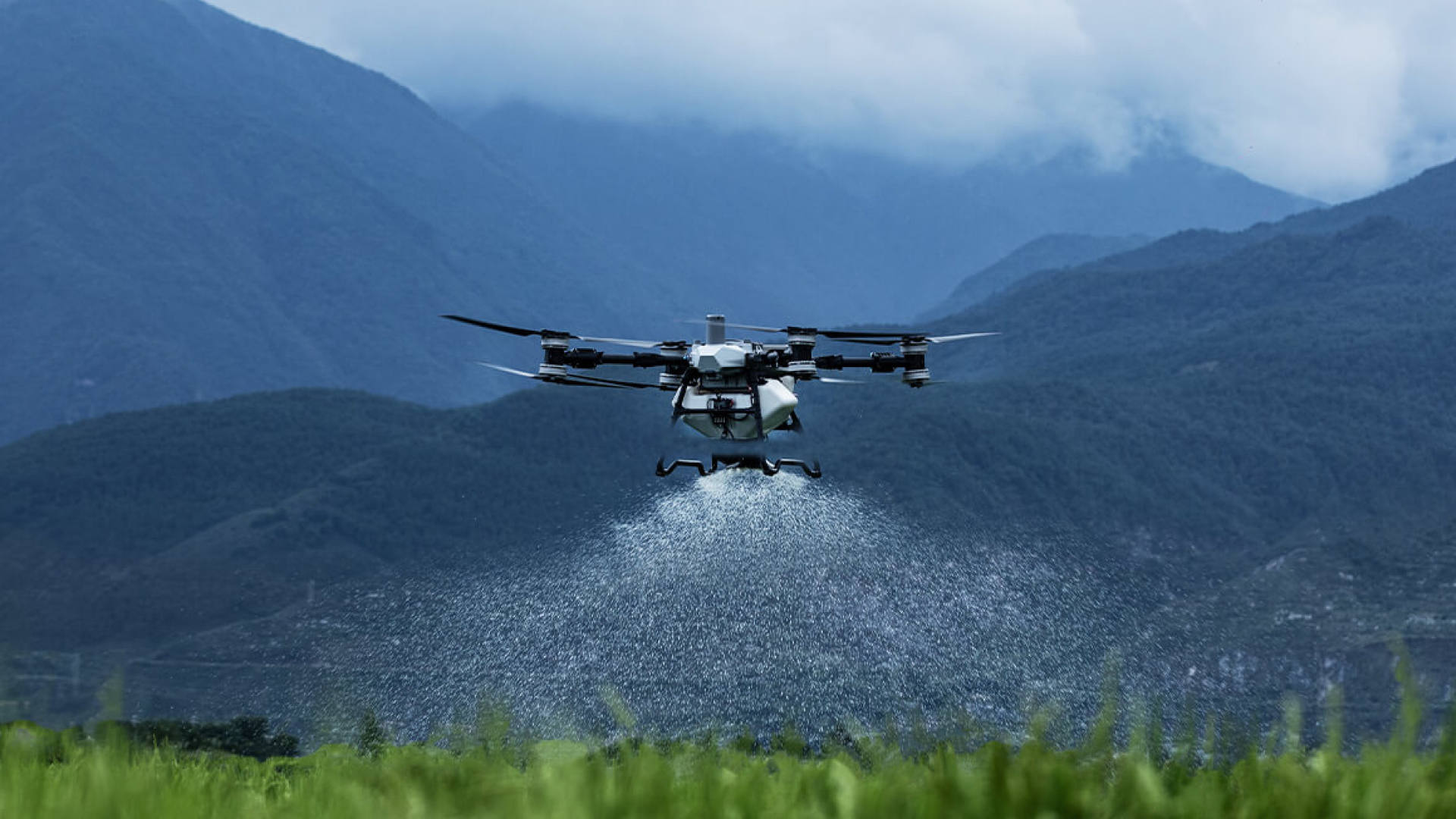
The DJI Agras T100 is DJI’s largest agricultural drone so far. It carries a 100 liter spray tank or up to 100 kg of granular material, and covers around 40 to 70 acres (16 to 28 hectares) per hour, depending on crop and terrain. It’s a strong fit for large, contiguous plantations like palm oil, rubber, rice, and sugarcane, where scale justifies the investment. It’s not automatically the right choice for smaller or fragmented plots, where a mid-size drone like the T40 or T50 often gives better cost per hectare. Terra Agri sells the DJI Agras T100 in Indonesia and Malaysia, and pairs it with spraying services, pilot training, and maintenance support.
What the T100 Actually Is, Beyond the Marketing Sheet
Every DJI launch gets called revolutionary. It’s more useful to look at what actually changed mechanically and what that means once the drone is in a real field.
The T100 uses a coaxial eight motor layout: four arms, each carrying two motors stacked one above the other. That’s not just about raw lifting power. Coaxial pairs let DJI keep the airframe fairly compact while nearly doubling thrust compared to one motor per arm, which is how a machine this size can carry a genuinely useful payload without needing a huge frame to match. The tradeoff is that more motors and ESCs mean more points of failure and a heavier maintenance checklist than a DJI T40 or T50.
A few numbers that actually matter once you’re running this thing day to day:
1. Payload: 100 L liquid tank, or up to 100 to 150 kg of granular fertilizer or seed through the spreading hopper
2. Coverage: roughly 40 to 70 acres per hour for spraying, more for spreading, depending on flight speed and swath settings
3. Battery: DB2160 intelligent batteries (41,000 mAh) with an 8 to 9 minute recharge on the matching charging station. This is really the productivity lever, since a big tank doesn’t help much if you’re standing around waiting for batteries
4. Sensing: RTK positioning for centimeter level accuracy, phased array radar with 60 m detection and full 360 degree horizontal, 180 degree vertical coverage, plus LiDAR terrain mapping for uneven ground
5. Max takeoff weight: around 225 kg fully loaded, a figure that matters more than most spec sheets let on
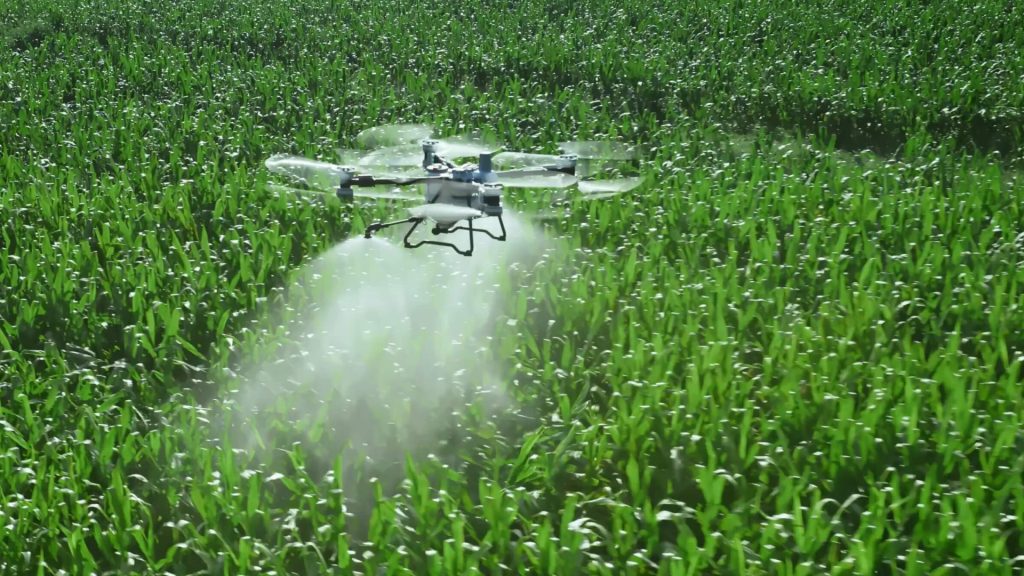
The Honest Tradeoff: Why a Bigger Tank Isn’t a Free Upgrade
A bigger tank sounds like a straightforward win. Fewer refill stops, more hectares per battery cycle. In practice, there are three engineering realities worth thinking through first.
Weight changes how the drone flies
At close to 225 kg fully loaded, the T100 sits well above the class most operators are used to flying. Heavier aircraft need more clearance around obstacles, more careful route planning, and more pilot skill to fly safely, especially on the uneven terrain common in palm oil estates. That’s not really a downside, it’s just a different operating discipline than a lighter T40.
Heat management is a real variable, not a footnote
Field reports on the T100 have noted that the atomizer and battery systems can run warmer at lower spray flow rates, which is part of why DJI recommends rotating through several battery packs with active cooling rather than pushing one pack through a long shift. For an operations manager, that means budgeting for a cooling station and enough batteries, not just the airframe cost.
A wider swath doesn’t automatically mean better coverage quality
Covering ground faster is only useful if droplet distribution stays even across that wider swath. Field agronomists are still calibrating settings for this kind of coverage width, so it’s a genuine engineering question, not a solved problem out of the box.
None of this makes the T100 a bad machine. It just means it rewards operators who fly it as a scaled up commercial tool, with proper batteries, cooling, and pilot training, rather than treating it as a bigger version of a hobbyist spray drone.
Who the T100 Actually Makes Sense For
If you’re weighing this purchase, the real question isn’t whether the T100 is impressive. It obviously is. The question is whether your operation’s layout actually matches what a 100 L tank is built for.
Good fit:
1. Palm oil estates with large, contiguous blocks, where fewer and longer flight legs cut down turnaround time
2. Rubber and sugarcane plantations with wide, open canopy access
3. Operations already running a fleet of smaller drones that want to consolidate acreage into fewer aircraft
4. Agribusinesses spraying or fertilizing often enough that battery and maintenance overhead gets spread across many flight hours
A mid-size drone like the T40 or T50 is often the smarter buy when:
1. You’re a smallholder cooperative or working fragmented plots, where flight legs stay short no matter how big the tank is
2. You don’t yet have a charging setup in place, since the T100’s power infrastructure adds real upfront cost
3. Your pilot team is still building up licensed capacity, since a heavier aircraft raises the skill floor
A genuinely useful ROI conversation compares cost per hectare treated, not just tank size or headline acres per hour. A bigger drone that sits idle waiting for a battery, or that needs a second person for safety oversight, can end up costing more per hectare than a smaller drone that just runs continuously.
Why Plantations in Indonesia and Malaysia Are Paying Attention
Palm oil in particular has a spraying and fertilization problem that manual labor struggles with: large canopy areas, difficult undergrowth terrain, and a persistent labor shortage during peak application windows. A drone that can move 100 kg of fertilizer or 100 L of liquid per flight, recharge in under 10 minutes, and navigate terrain on its own using LiDAR is solving a real operational bottleneck, not just offering a nice-to-have efficiency gain.
That said, bringing in a drone this size is an operational decision, not just a purchasing one. It touches pilot licensing, battery logistics, spare parts availability, and field calibration, which is exactly where having a local service partner matters.
Terra Agri: Sales, Service, and the DJI Agras T100
Terra Agri is an official DJI sub-dealer for agricultural drones in Indonesia, and we sell the DJI Agras T100 directly. But the drone itself is only part of what makes a spraying or fertilization program actually work.
Alongside the T100, Terra Agri provides:
– Sales of the DJI Agras T100 and other Agras models, matched to your plantation’s actual acreage and terrain
– Spraying and spreading services, if you’d rather contract the work out than build your own fleet
– Pilot training and certification support, addressing the skill floor question above
– Maintenance and spare parts, so aircraft downtime doesn’t stall your application schedule
– Mapping and precision agriculture support, using the same platform for field survey work between spray cycles
If you’re trying to work out whether the T100 is the right size for your operation, or whether a smaller Agras model actually fits your plantation better, that’s the kind of assessment worth doing before you buy, not after.
Interested in whether the DJI Agras T100 fits your plantation’s scale? Terra Agri can assess your acreage and terrain and recommend the right drone and service package.
Frequently Asked Questions
The T100 carries up to 100 liters of liquid for spraying, or up to 100 to 150 kg of granular material for spreading, depending on the hopper setup.
Roughly 40 to 70 acres (16 to 28 hectares) per hour for spraying, and more for spreading, depending on flight speed, swath width, and terrain.
Around 8 to 9 minutes using the matching DJI charging station. That fast turnaround is the main reason the T100 can keep running through most of a shift.
es, particularly for large, contiguous blocks, where its higher payload and coverage rate cut down the number of flight legs needed per hectare. Smaller or more fragmented plots may actually get better cost efficiency from a mid-size Agras model.
Terra Agri, part of Terra Drone Agri, sells the DJI Agras T100 as an official DJI sub-dealer, alongside spraying services, pilot training, and maintenance support.
Not necessarily. The T100 makes the most sense once scale, battery infrastructure, and pilot capacity are already in place. Smaller operations often get better cost per hectare results from mid-size drones.