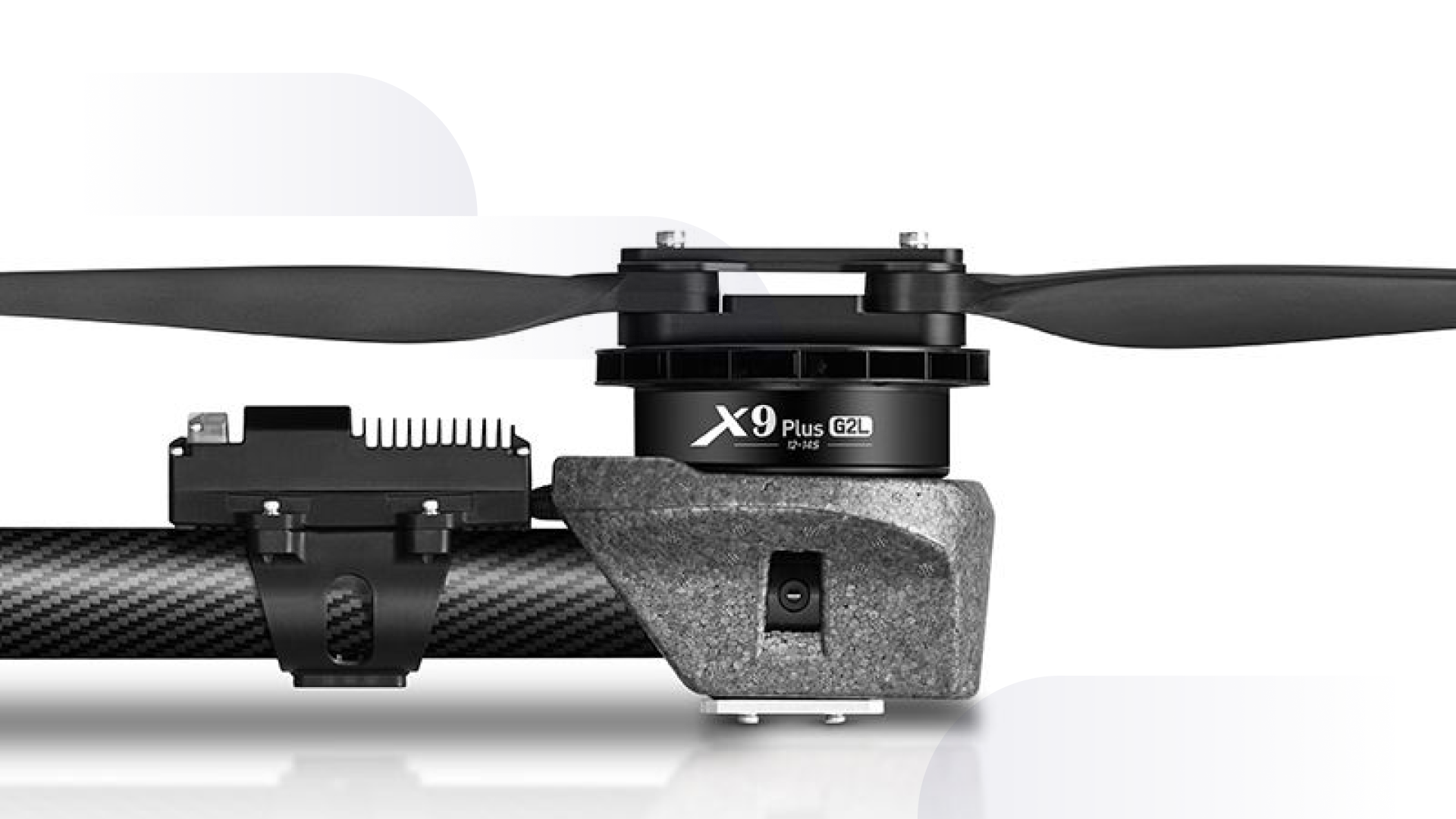
Agricultural drones use brushless motors. Brushed motors survive mainly in toy and micro drones, because their brushes wear out, they lose more energy as heat, and they cannot carry the heavy, continuous loads of crop spraying. For plantation work in humid, chemical-heavy conditions, the motor’s sealing and corrosion protection matter as much as the brushless design itself.
How brushed and brushless drone motors work
Both motor types run on the same principle: a magnetic field pushes a rotor around. The difference is how the field is switched on and off.
Brushed motor
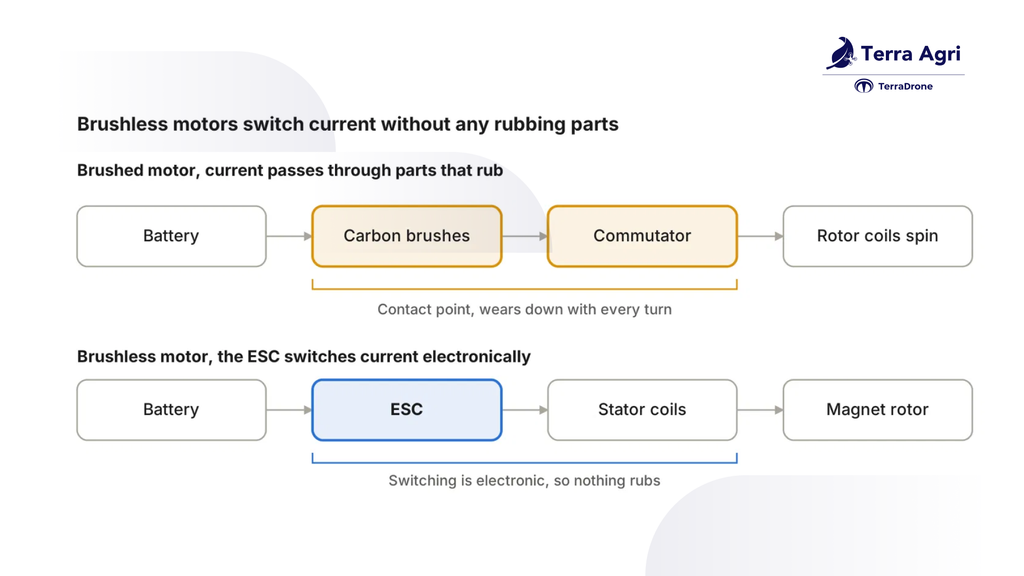
A brushed motor uses physical contact. Carbon brushes press against a rotating commutator and pass current into the coils on the rotor. Every rotation means the brushes rub against the commutator, so the parts wear down, create friction and throw off sparks and dust over time.
Brushless motor (BLDC)
A brushless motor (BLDC) removes that contact. The rotor carries permanent magnets and the stator carries the coils. An electronic speed controller (ESC) switches the current between coil phases at precisely timed moments, so nothing inside needs to touch to keep the motor turning. A brushless motor cannot run directly from a battery. It always needs an ESC, and on modern agricultural drones the ESC and motor are tuned as one system.
That extra electronics layer is also why brushless motors dominate drones that must be controlled precisely. The flight controller sends throttle commands to the ESC hundreds of times per second, and the ESC adjusts each motor’s speed to keep the aircraft level, even with a tank full of liquid sloshing underneath.
Brushed vs brushless drone motors: side-by-side comparison
| Factor | Brushed motor | Brushless motor |
|---|---|---|
| Commutation | Mechanical (brushes and commutator) | Electronic (ESC) |
| Lifespan | Short; brushes wear with every rotation | Long; no contact between rotor and stator, bearings are the main wear part |
| Efficiency | Commonly cited around 80% | Commonly cited 85% to 90% |
| Power for its size | Lower | Higher, which suits heavy-lift spraying |
| Maintenance | Brush and commutator replacement | Bearing checks, cleaning, corrosion control |
| Upfront cost | Low | Higher, plus an ESC |
| Control | Simple, runs without a dedicated ESC | Needs an ESC, which allows precise speed control |
| Typical use | Toy drones, micro indoor drones | Professional, industrial and agricultural drones |
The efficiency figures are general ranges quoted across the industry, not a measurement for any specific agricultural motor. What matters for a plantation operator is the pattern. Brushed motors are cheap to buy and expensive to keep running. Brushless motors reverse that, which is why the total cost of ownership favors brushless as soon as a drone flies daily.
Why agricultural drones use brushless motors
Agricultural drones work harder than almost any other commercial drone. They lift a heavy liquid payload, fly low over crops, and operate in rain, mist, dust and pesticide spray. Five requirements explain why brushless is the only realistic choice.
1. Thrust that holds up under load
A spraying drone that lacks thrust becomes unstable at low altitude, and unstable flight means uneven pesticide distribution. Brushless motors deliver more power for their weight, which is what a full tank demands.
2. Long duty cycles
Spraying means repeated take-offs with heavy tanks, battery swap after battery swap. Without brushes to wear out, the motor’s service life is set by its bearings and sealing instead of a consumable part.
3. Sealing against water and dust
A brushed motor wears internally through brush contact, so debris from that wear stays inside the housing. A brushless motor has no such internal contact, which lets manufacturers build closed, waterproof designs. Agricultural propulsion systems such as Hobbywing’s X8 are rated IPX6 or IPX7.
4. Resistance to chemical corrosion
Pesticide splash attacks coils, magnets and bearings. Agricultural brushless motors use coil coatings and waterproof bearings to survive repeated exposure.
5. Precise control through the ESC
Modern agricultural motors pair with a field-oriented control (FOC) ESC, which tunes the motor, ESC and propeller as one balanced system for stability and efficiency.
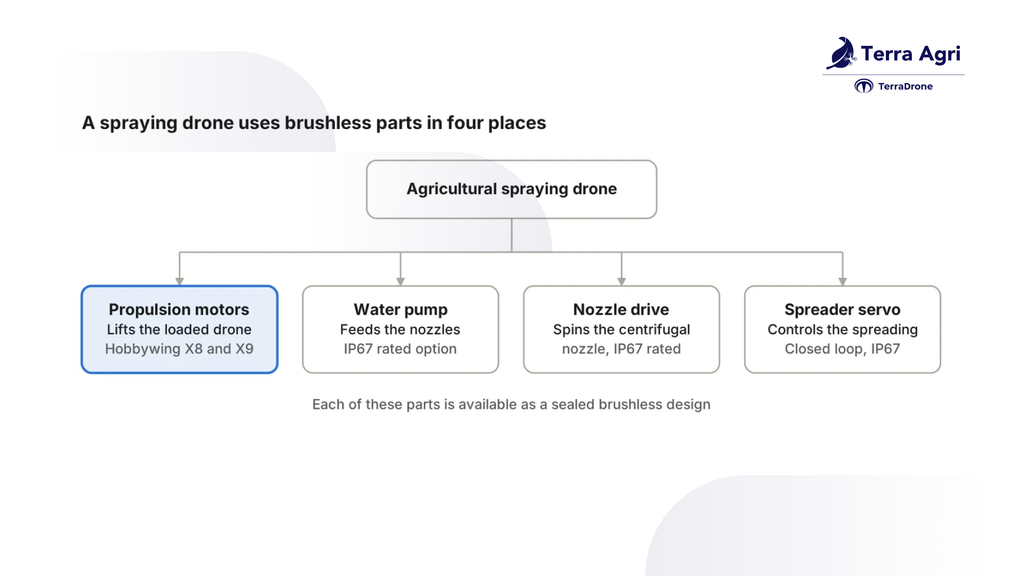
The same logic has spread beyond the propulsion motors. Brushless technology now appears in agricultural drone water pumps, centrifugal spray nozzle drives and spreader servos, mostly for longer life and IP67-class protection. Hobbywing, for example, claims its brushless pump lasts 3 to 5 times longer than an ordinary pump.
For operators in Indonesia and Malaysia, the tropical climate adds one more reason. Daily rain, high humidity and frequent washdowns punish any open or poorly sealed motor, and oil palm estates add dust, mud and chemical exposure on top.
Brushless is not maintenance-free: what to check on agricultural drones
Brushless removes the brush problem. It does not remove field wear. In plantation conditions, the parts that fail are different ones.
1. Bearings
With no brushes to wear, bearings carry the mechanical load. Water, mud and pesticide residue shorten their life, which is why sealed, waterproof bearings are a selection criterion.
2. Corrosion
Chemical residue left on a motor keeps working on coatings and metal parts after the flight ends.
3. Heat
Overloading a propulsion system raises motor and ESC temperature quickly. Hobbywing’s X8 G2 manual warns about this and advises against exceeding the rated load.
4. Crash damage
Impact can bend shafts or damage the motor even when the housing looks intact.
A routine that matches manufacturer guidance:
1. Flush the motor with clean water after each spraying operation. Hobbywing’s X8 G2 manual calls for this, and the motor mount is built with drain outlets to allow it.
2. Check that arm and mount screws are tight and the motor is level before every flight.
3. Spin each motor by hand and listen for roughness, grinding or wobble in the bearing.
4. Do not open the motor or ESC yourself. The manufacturer warns that this can damage the motor or weaken the ESC’s protections.
5. Replace the full motor or ESC when a fault appears, and keep matched spares on hand so a down drone does not stop a spraying schedule.
Hobbywing X8 and X9: brushless propulsion systems for agricultural drones
Hobbywing’s X Series is built for precision agriculture drones. Each system combines a brushless motor, an ESC and a matched propeller into one plug-and-play unit, designed to cope with dust, rain and chemical corrosion. Terra Drone Agri supplies the X8 and X9 for operators who need reliable replacement or upgrade propulsion.
| Specification | Hobbywing X8 G2 | Hobbywing X9 |
|---|---|---|
| Rated load per rotor | 5 to 7.5 kg | 7 to 11 kg |
| Drone class | 20 to 30 kg takeoff weight | 16 L sprayers |
| Battery | 12S to 14S | 12S to 14S |
| Arm tube diameter | 35 mm or 40 mm | 40 mm |
| Listed weight | 1,095 g | 1,524 g |
| Design | Brushless, built for agricultural plant protection drones | Brushless, built for agricultural drones |
Which one fits?
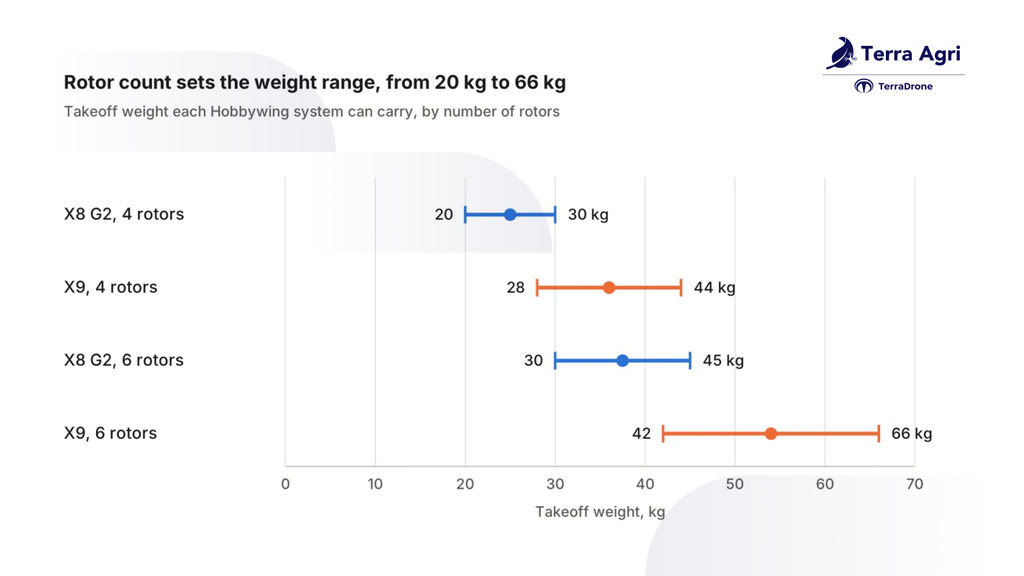
The rated load per rotor, multiplied by the number of rotors, gives a rough takeoff weight range the system can carry. On a quadcopter, the X8 G2 covers about 20 to 30 kg (4 × 5 to 7.5 kg), which matches Hobbywing’s listed 20 to 30 kg drone class and suits mid-size spraying and spreading platforms. The X9 covers about 28 to 44 kg on a quadcopter (4 × 7 to 11 kg) and more on six or eight rotors, so it suits larger-tank sprayers that need more thrust per rotor. This is simple arithmetic on rated load, not maximum thrust, so leave margin for a full tank, wind and hot, humid air. Match the choice to the drone’s takeoff weight, not to the tank label alone, and confirm the exact variant against the manufacturer’s spec sheet, since Hobbywing offers several generations and sizes within each series.
In plantation use, add the working conditions to the weight calculation. Oil palm blocks mean frequent rain, mud, dust and pesticide exposure, so the sealing, corrosion protection and post-spray rinsing described above matter as much as thrust. A motor sized with headroom also runs cooler, which protects the motor and ESC over a full spraying day.
Need an X8 or X9 for your fleet? Check our Tokopedia store.